Charging time, range anxiety, and long-distance travel are common concerns with electric vehicles. Different types (BEVs, PHEVs, HEVs) support various charging speeds and connectors, from slower Type 1 and Type 2 to faster CCS and CHAdeMO. Home charging is usually the slowest, while rapid chargers at service stations are quickest. Battery size also affects charging time, with larger batteries taking longer to fill. This guide looks at charging options, speed and debunks general EV charging worries. 


Whether you’re looking for your first electric vehicle or you’re an EV owner looking for a new model, you’ll likely have a lot of questions about charging. Below, we'll debunk the process, so you can drive with confidence.

01
What are the different types of electric cars?
Different types of electric cars utilise different methods of charging, so it helps to know more about the various types of EVs that you can choose from, such as:
BEVs (Battery Electric Vehicles)
This type of electric car is powered solely by an electric battery. They produce zero emissions and don’t rely on gas engine parts.
PHEVs (Plug-in Hybrid Electric Vehicles)
This type of EV has a battery and an electric motor, as well as a petrol fuel tank and a charging port. Your vehicle will switch between electric and petrol depending on your driving conditions.
HEVs (Hybrid Electric Vehicles)
Similar to the plug-in hybrid, HEVs are low-emission vehicles that use an electric motor to assist the engine. They use regenerative braking — the process of converting the energy lost when the vehicle breaks — to recharge the battery. They have a very short electric range; most of the energy comes from fuel.
BEVs (Battery Electric Vehicles)
This type of electric car is powered solely by an electric battery. They produce zero emissions and don’t rely on gas engine parts.
PHEVs (Plug-in Hybrid Electric Vehicles)
This type of EV has a battery and an electric motor, as well as a petrol fuel tank and a charging port. Your vehicle will switch between electric and petrol depending on your driving conditions.
HEVs (Hybrid Electric Vehicles)
Similar to the plug-in hybrid, HEVs are low-emission vehicles that use an electric motor to assist the engine. They use regenerative braking — the process of converting the energy lost when the vehicle breaks — to recharge the battery. They have a very short electric range; most of the energy comes from fuel.
02
What are the different types of EV charging stations?

Did you know there are different types of electric car charging stations? The type you use affects how long it takes to charge an EV. Where you are and how long you have to charge the vehicle before getting back on the road also play a part.


Home Charging:

There are two options for charging your car at home;


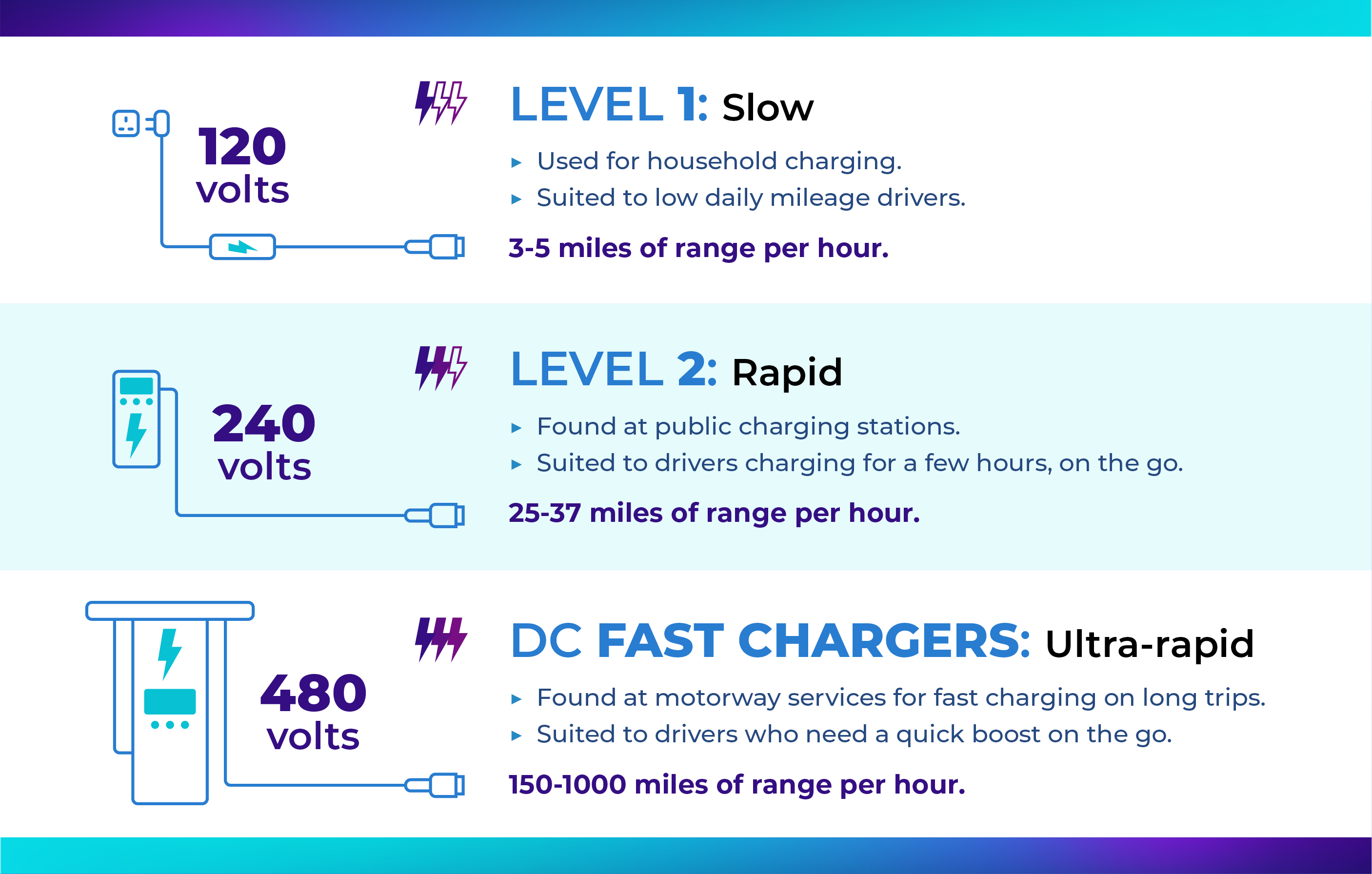
Level 1 (slow - 120 volts): plugging your car into a standard three-pin household socket

Level 2 (fast - 230 volts): charging a dedicated home charging point at your property.


Level 1 (slow - 120 volts) Level 2 (fast - 230 volts)
This is the slowest charging level, but can be useful if your car is parked for several hours or overnight. This type of charging is typically used as a temporary option, as it requires your car charger to be plugged into your household mains via a standard three-pin socket. When plugging into this charger, your vehicle may take up to 12 hours to charge an empty battery to full. It’s recommended to install a 7kW home EV charger (which will charge your vehicle more quickly than the above 2kW option) to benefit from effective charging when parked at home. These home chargers are installed by an electrician and can typically charge an empty battery to full in 6-8 hours.

Public charging:

Level 2 (fast - 240 volts) DC fast chargers (ultra-fast - 480 volts)
This level involves rapid charging that is typically found in public charging stations. It can charge most electric vehicles in under an hour. Ultra-rapid chargers are much faster and can charge electric vehicles in as little as 30 minutes, making them ideal for quick stops during long journeys.

As well as different levels of charging, electric vehicles have different charger connections or ports. Some examples of these include:


Type 1: A standard connection which is relatively slow, used for level 1 and 2 charging. It’s the standard for electric vehicles in America and Asia. It allows for charging the car at speeds of up to 7.4 kW, depending on the charging power of the vehicle and the capacity of the electrical supply network. They’re used in home charging and public charging scenarios.


Type 2: These plugs are classed as three-phase plugs because they use three conductors within the charger. Because of this, they can charge the car faster. At home, the highest charging speed is 22 kW, while public charging stations can have a charging power of up to 43 kW, depending on the charging power of the car and the capacity of the network. These chargers are used by many European manufacturers as standard.


CCS: This is an extension of the Type 2 connector, combining Level 2 and DC Fast Charging. The CCS plug has two additional power contacts for fast charging, allowing vehicles to charge at speeds of up to 350 kW. This reduces charging times on long journeys.


CHAdeMO: An abbreviation for ‘Charge de Move’ or ‘charge for moving’. This connection is used for DC Fast Charging. It’s used worldwide in conjunction with Type 1 and Type 2 connectors. Developed in Japan, this charger allows for very high charging capacities. This charger offers some of the most powerful charging capabilities, making it compatible with EVs with large batteries.


The type of connection your vehicle has will be dependent on the manufacturer, the region you live in, and the desired charging speed.

03
EV home charging stations

When you purchase an electric vehicle, you’ll need a way of charging it when it’s not being used. This is where EV home charging comes in. While one option is to use a standard three-pin plug, this can take a long time, so you may want to purchase a home charging point. These typically cost around £800-£1000, with some providers offering installation as standard. Your home EV charging point will typically be a level 1 charger so you can keep your electric vehicle plugged in overnight, ready for when you need it next.


Another option that is growing in popularity is the option of lamp posts and bollard charging. Essentially, charging facilities are built into these common items. If you have access to them, they’re a great option for taking advantage of public charging close to home.

04
EV public charging stations

Public chargers tend to be situated in urban areas, service stations, and along major travel routes so you can keep your EV charged no matter how far you’re driving. These chargers allow you to top up when you’re shopping, working, or taking a rest at a service station.


Public EV charging stations typically have level 2 or DC fast chargers, so you can top up quickly and easily. While payment is required each time you charge at a public charging point, this is made easy with the option to use an app so you can pay securely from your phone.


You can find network charging maps online so you can plan your journey, for peace of mind that you can charge on the go.

05
How long does it take to charge an EV?

There are a few factors that contribute to how long it takes to charge an EV, including:

Battery capacity
The size of your EV’s battery and its state of charge determines how long it takes to reach capacity. A typical EV with a 60kWh battery will take just under 8 hours to charge from empty to full with a 7kW charging point installed at home. Charging tends to slow down as the battery approaches full charge to prevent overheating and protect battery life.
Charging speed
The type of EV charger and station you use has an impact on charging speed. A higher voltage can result in faster charging, with DC fast chargers providing a rapid charging solution.
Charging station
The type of EV charging station you choose plays an important role in how long it takes to fully charge. Level 1 EV chargers installed at home, for example, will take longer to charge your car than level 2 and DC fast charging stations.
06
Can I travel long distances in my EV?

In short - yes, you can.


Advancements are improving EVs, meaning many fully electric vehicles (BEVs) are equipped with a larger battery capacity. The addition of EV charging stations supports longer-distance driving.


For example, the BYD DOLPHIN in both Comfort and Design specifications offers a range of 265 miles with the help of a 60.4kWh battery, working out at 3.9 mi/kWh.


The BYD SEAL offers a range of 354 miles, powered by the 82.5kWh battery - which equates to approximately 3.74 miles/kWh.


*The above figures are dependent on driving conditions and external factors like the weather. Actual range achieved may be less than this.

07
What is range anxiety?

Range anxiety is a fear many EV drivers have when it comes to the distance they can drive in one charge.This worry comes from the perception that electric vehicles have a limited range compared to traditional fuel-powered vehicles.


However, as electric vehicles become more popular, EV range anxiety is likely to decrease due to education and awareness of their capabilities, as well as further technological advancements in infrastructure.


BYD is an industry leader when it comes to incorporating the most innovative Blade Battery into EVs. Many of our vehicles also use advanced energy-saving heat pumps as standard, showcasing the highest quality technology for an enhanced driving experience.


Discover all BYD electric vehicles today. Find out more about each of our models, as well as more about driving an EV in our electric car guides.

How to charge an electric car FAQs

Can I use any public charger to top up my car’s battery?

No, not every charger will be compatible with your car. You’ll need to check the connector to make sure it’ll work with your EV. You’ll also need to check whether your charger is tethered or untethered. If you choose an untethered option, you’ll need your own cable.

Does the battery charge at the same speed the whole time?

No, as the battery approaches 80% full, it slows down. This is to prolong the battery's lifespan and maintain its efficiency.

Is it cheaper to charge at home?

Yes, most of the time, charging at home is cheaper. The initial cost of installing an at-home charger can be around £800+ with installation, but using your own EV charger will save money over time. Some energy providers also offer off-peak rates, making it even more affordable.

Does temperature affect charging time?

Extreme heat and extreme cold can make charging slower as the battery has to work to regulate its temperature. Cold temperatures also make it harder for the battery to accept a charge, taking longer to top up.

Can I install a home charger myself?

It’s always best to get a technician to do this for you, to ensure a safe installation and so you can get the most from your charger. Many home charger suppliers offer an installation service when you buy the charger from them.

Back to top